


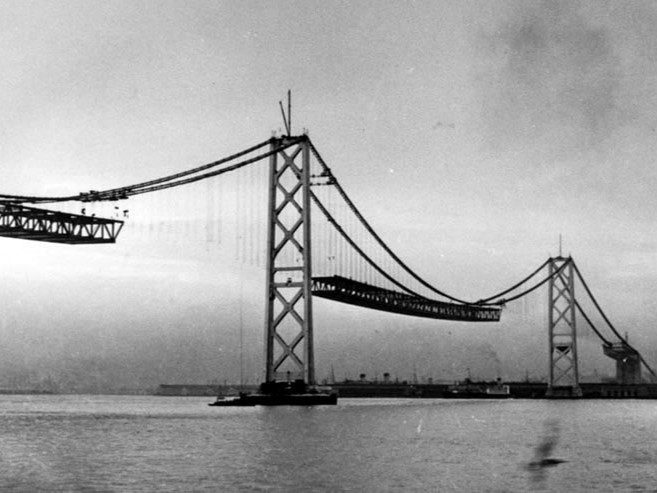
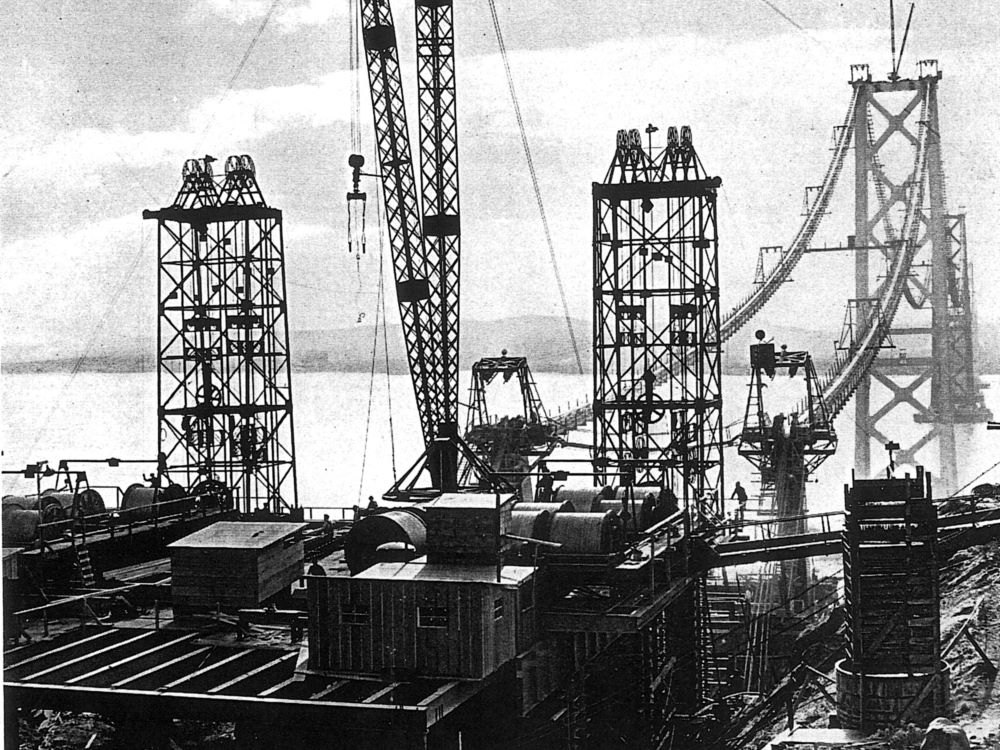
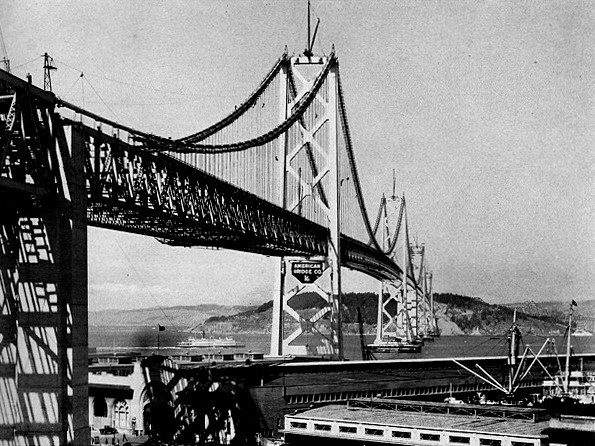
Completed in 1936 by American Bridge, the San Francisco – Oakland Bay Bridge – East and West Spans project consisted of the prime superstructure contract for this 22,000’ (6,800m) crossing of the San Francisco Bay. The work included two back-to-back suspension bridges, a major cantilevered truss, and many approach spans. American Bridge erected a total of 167,100 tons (152,000mt) of structural steel for the project, including 19,100 tons (17,300mt) of airspun main cables. The two suspension bridges span the west portion of the bay, between San Francisco and Yerba Buena Island. These bridges have a suspended length of 9,271’ (2,825m) and have four steel towers rising to a height of 515’ (157m). The cables were airspun in 37 strands of 472 wires each, pulled in two loops. There is a total of 21,465’ (6,500m) of main cable, and 1,192 bridge rope suspenders. The cantilevered truss and approaches span the east portion of the bay, from Yerba Buena Island to Oakland. This section consists of a three-span cantilevered truss of 508’+1400’+512’ (154m+427m+156m), five spans of 509’ (155m) trusses, 14 spans of 288’ (88m) trusses, plus a four-span curved truss at Yerba Buena Island. Both bridges are double-deck from start to finish, enabling the transit of 12 lanes of traffic – six on the upper deck and six on the lower. The work was started on July 1, 1932, and completed on November 1, 1936.
Project Details
- Owner: Caltrans
- Location: San Francisco/Oakland, California, United States
- Performed as: American Bridge Company
- Project value: $78,000,000.00
- Completion Date: November 1936